Case Studies
The work, and what it actually produced.
Two named clients described by the fixes performed for them, and six sets of verified Search Console results from private client projects whose details are withheld by request.
Nothing here is a projection, an average, or an estimate — and no client’s numbers appear under another client’s name.
Named client work
These two clients agreed to be named. No Search Console export has been supplied for either, so no performance figures are shown — the case is made from the faults found and the work done, which is verifiable on its own terms.
Hampshire Motor Company
A full technical and local-SEO rebuild for a UK motor dealership — fixing what search engines could reach, understand, and trust locally.
The problem
The site was live but effectively invisible in search. Content did little to explain what the business offered, and its local presence on Google was inconsistent and under-maintained — so it rarely surfaced for the searches that actually mattered.
What the audit found
A structured technical audit of how the site was crawled, rendered, and indexed, alongside a review of the Google Business Profile and the local signals (citations, consistency, off-page footprint) that decide local visibility.
The work
- Technical SEO audit with a prioritized, impact-ranked fix list
- Full content rewrite so pages clearly describe the business and its services
- Google Business Profile rebuilt and properly optimized for local search
- Ongoing off-page work: backlinks and citation building for local authority
Outcome
The technical faults were resolved, the content now states plainly what the business does, and the local profile is consistent and active. Off-page work is ongoing. (No performance figures are published here — a verified Search Console screenshot has not been supplied, so no numbers are claimed.)
ForexGuru.pk
Untangling a large WordPress site that was sending search engines mixed, self-competing signals — then rebuilding it on clean technical foundations.
The problem
The site was leaking crawl budget across thousands of thin, auto-generated pages, while conflicting plugins quietly injected duplicate and broken markup. Search engines were getting contradictory signals about nearly every page.
What the audit found
A technical audit traced the root causes: 1,091 auto-generated tag pages competing with the real content, and 43 plugin conflicts producing duplicate meta tags and malformed markup.
The work
- Technical SEO audit isolating the crawl and indexation faults
- Applied noindex to 1,091 thin tag pages to stop the crawl-budget leak
- Resolved 43 plugin conflicts injecting duplicate meta tags and broken markup
- Content improvements and the missing legal pages the site needed
Outcome
Search engines now receive one clean, consistent signal per page instead of thousands of competing ones, and crawl budget is focused on pages that matter. (No performance figures are published here — a verified Search Console screenshot has not been supplied, so no numbers are claimed.)
Private local-search project
From scattered local visibility to a stronger map-pack footprint.
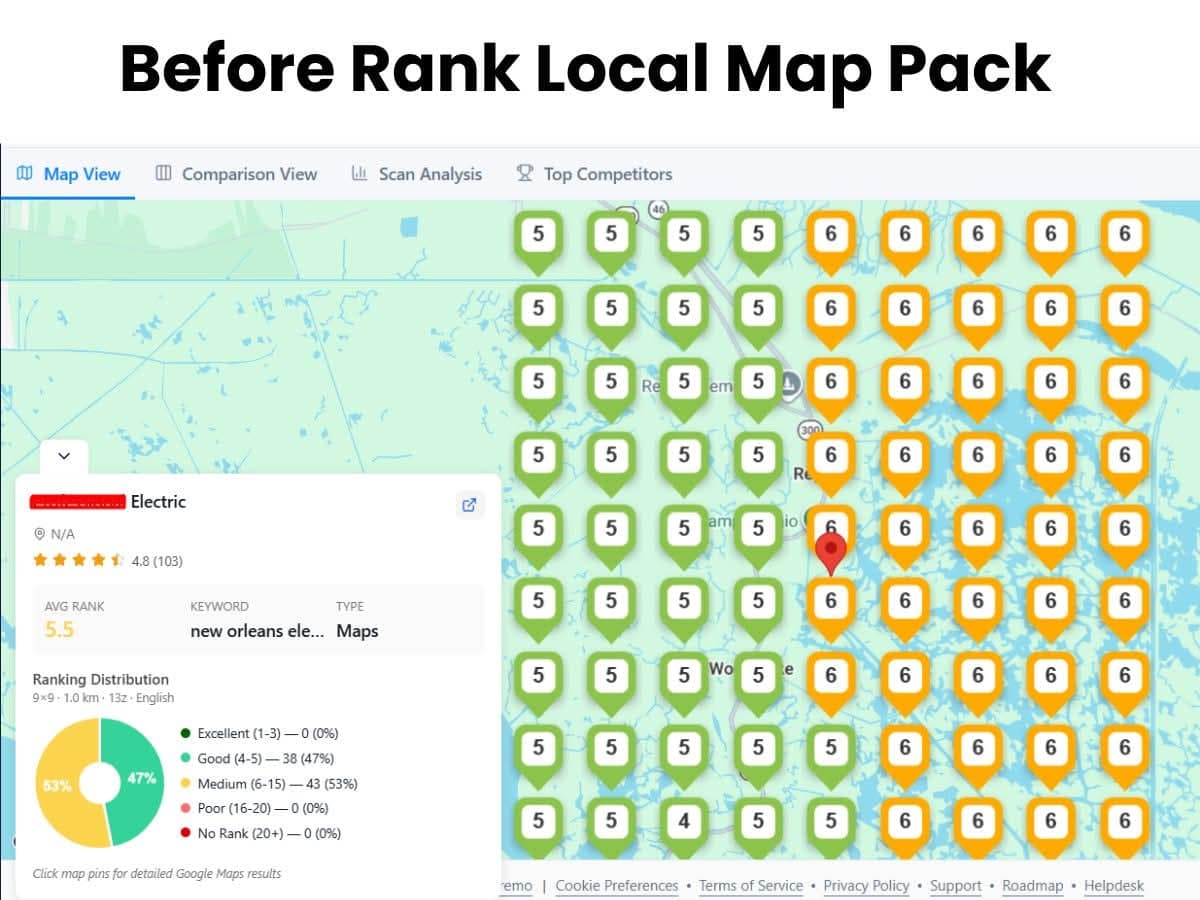
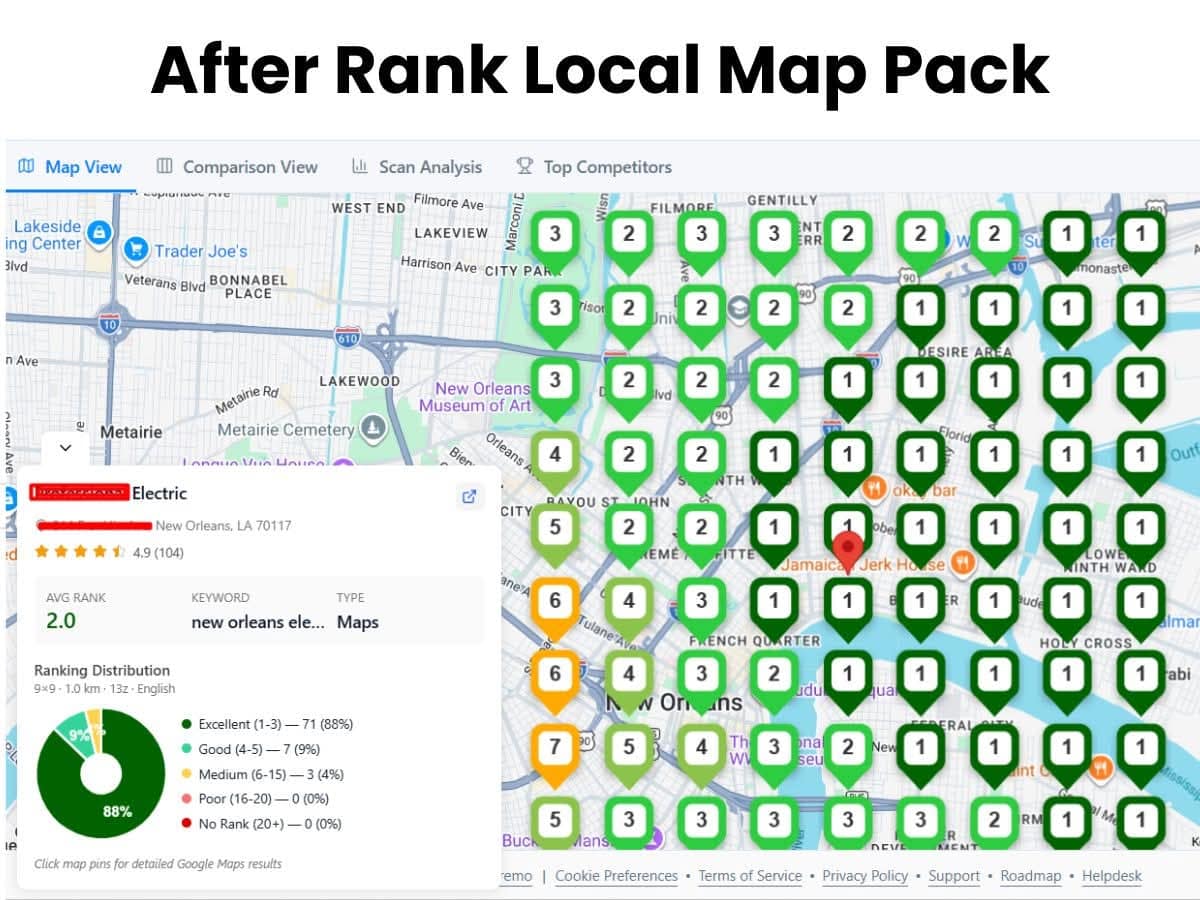
The supplied Before/After report shows average map-pack rank moving from 5.5 to 2.0, with 88% of tracked results in positions 1–3 after the work.
What the evidence shows
The Before report shows a local visibility distribution concentrated outside the strongest map-pack positions. The After report shows the project’s average rank at 2.0 and the majority of tracked results in positions 1–3.
What remains private
Client identity and reporting period are not published. The exact implementation sequence is not inferred from the screenshots, so this page does not assign the result to off-page SEO, citations, reviews, or any single tactic.
Verified results, client details private
Every number below is read directly from the Google Search Console screenshot shown with it. Client details remain private, so no business name, URL, or logo appears — only the data itself.
Private client project
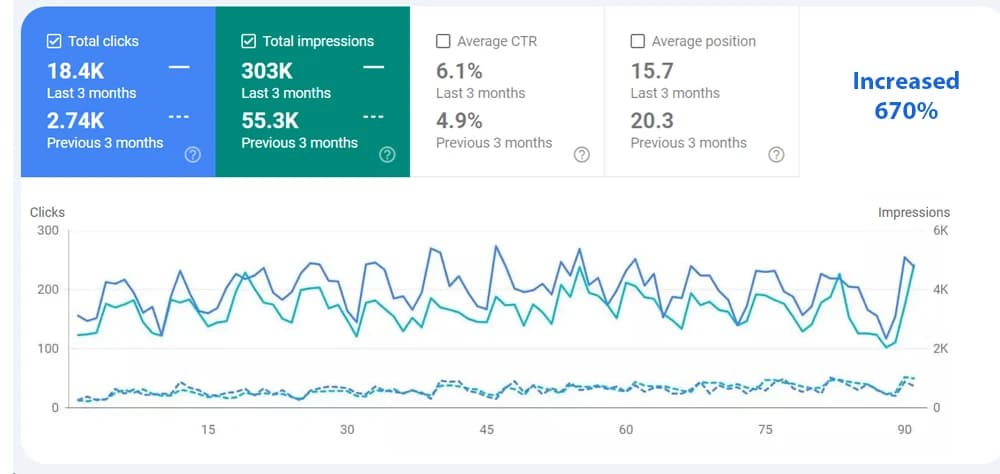
Organic clicks up 670%Client details withheld by request
Organic visibility rebuilt around pages Google could crawl and rank — clicks and impressions climbed together. Client details withheld by request.
- Clicks
- 18.4K
- from 2.74K
- Impressions
- 303K
- from 55.3K
- Avg. CTR
- 6.1%
- Avg. position
- 15.7
Private client project
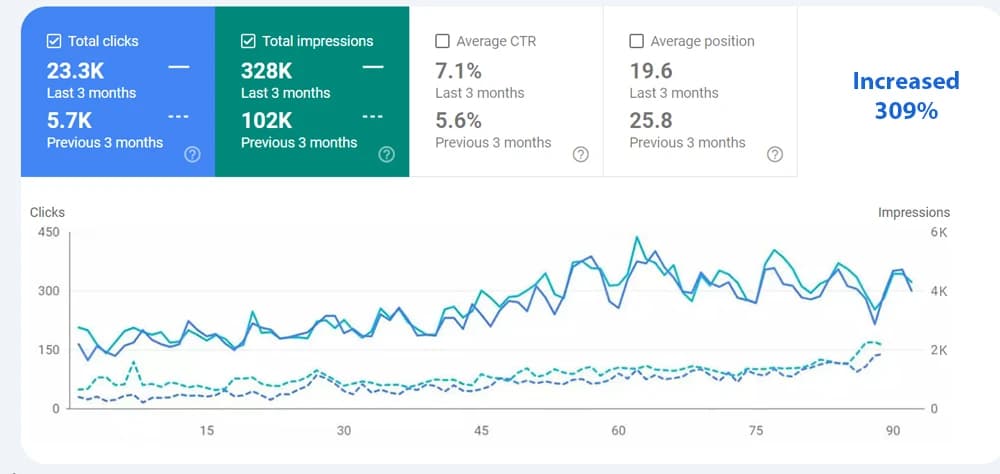
Organic clicks up 309%Client details withheld by request
High-intent pages that were stuck out of the results got fixed — search demand finally started converting to clicks. Client details withheld by request.
- Clicks
- 23.3K
- from 5.7K
- Impressions
- 328K
- from 102K
- Avg. CTR
- 7.1%
- Avg. position
- 19.6
New SaaS tool website
Ranking within 2 monthsClient details withheld by request · May–July 2026
A brand-new site earning near-page-one positions inside its first two months — visibility built from zero. Client details withheld by request.
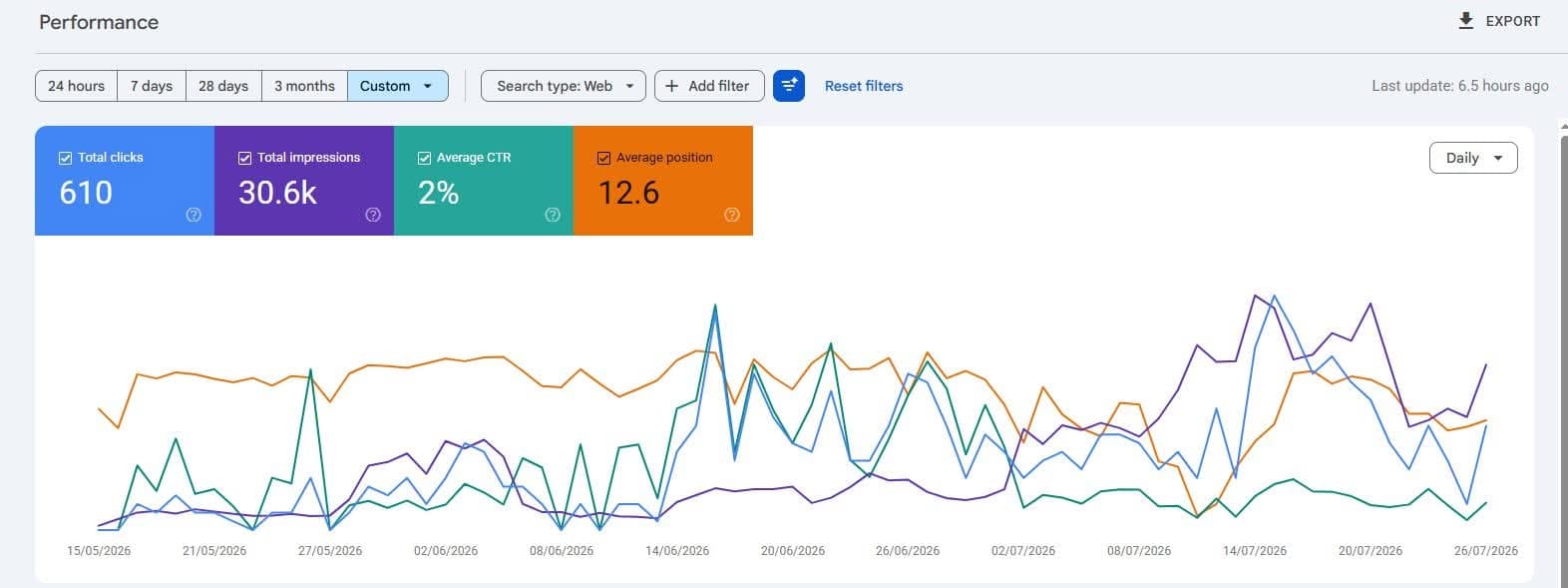
- Clicks
- 610
- Impressions
- 30.6K
- Avg. CTR
- 2%
- Avg. position
- 12.6
Gym & fitness website (USA)
Traction in a competitive US nicheClient details withheld by request
Organic visibility grown in a competitive US fitness niche, holding a strong average position at scale. Client details withheld by request.
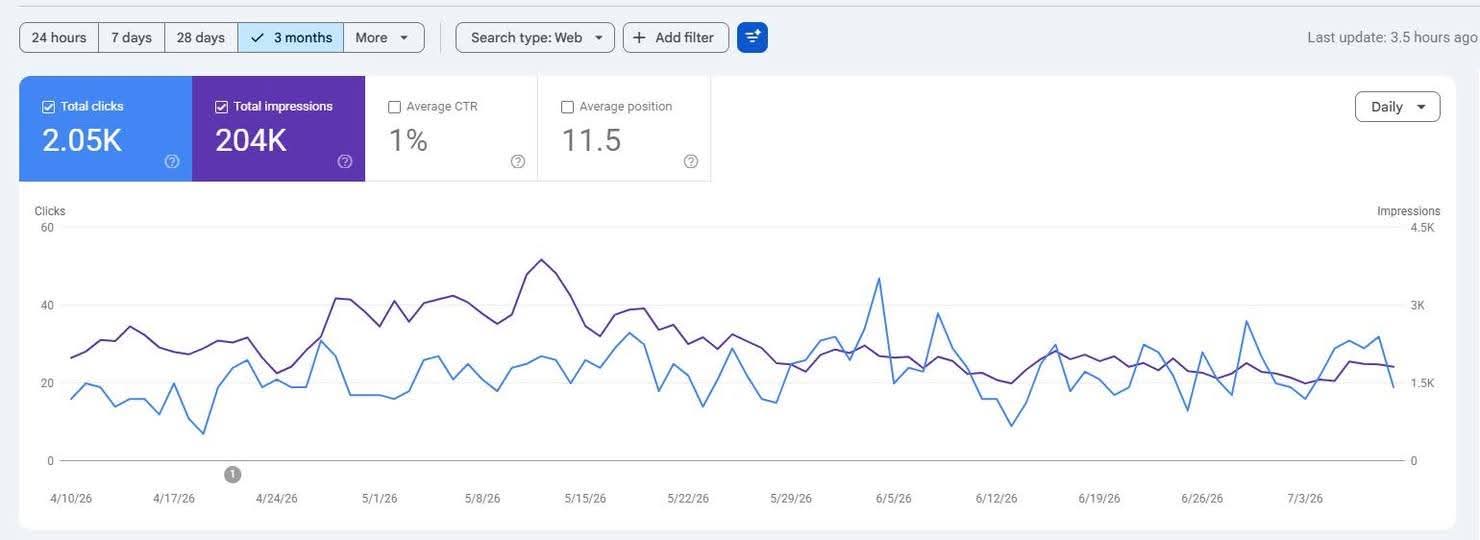
- Clicks
- 2.05K
- Impressions
- 204K
- Avg. CTR
- 1%
- Avg. position
- 11.5
High-reach content site
1.37M search impressionsClient details withheld by request
Search impressions scaled past 1.3M — the reach base an authority site needs before clicks compound. Client details withheld by request.
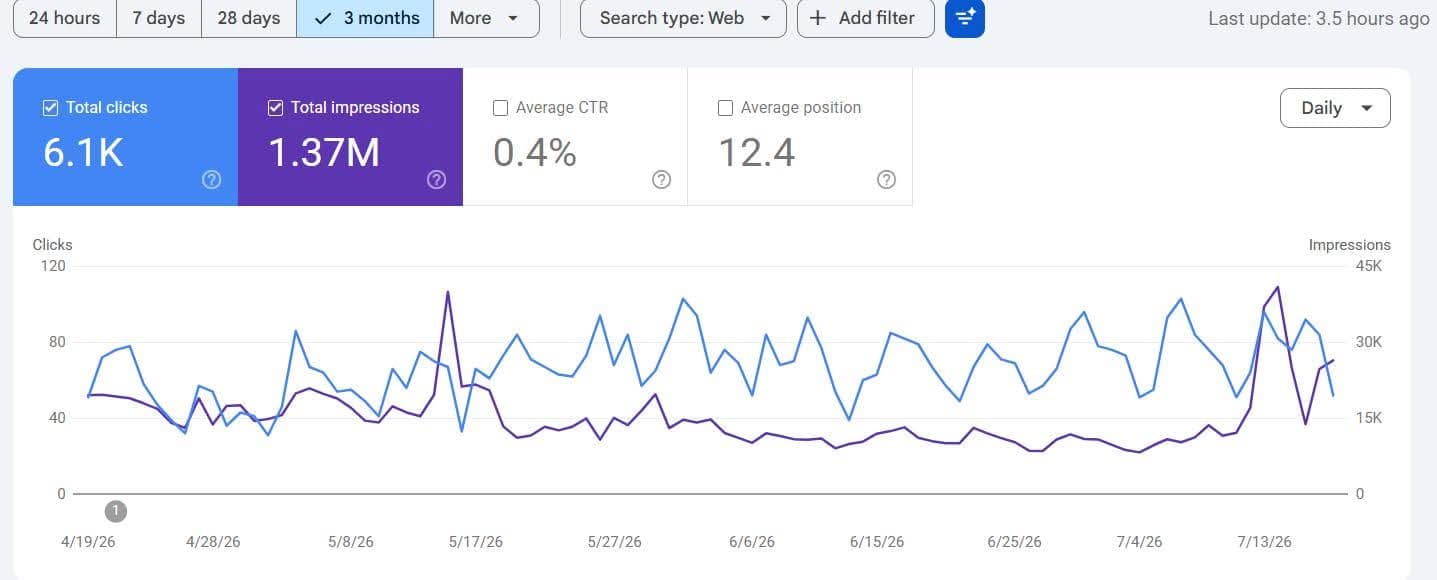
- Clicks
- 6.1K
- Impressions
- 1.37M
- Avg. CTR
- 0.4%
- Avg. position
- 12.4
Large-scale visibility build
985K search impressionsClient details withheld by request
Early-stage visibility push generating 985K impressions — the reach foundation to then convert into rankings and clicks. Client details withheld by request.
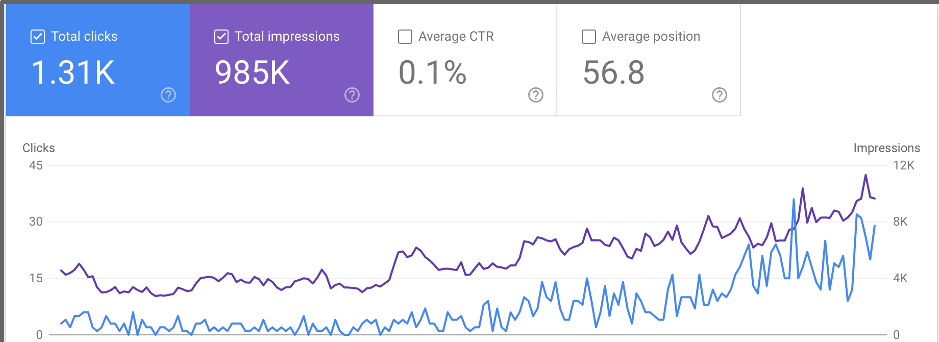
- Clicks
- 1.31K
- Impressions
- 985K
- Avg. CTR
- 0.1%
- Avg. position
- 56.8
Why some case studies have no numbers
A case study on this site shows metrics only when the client is correctly matched to the evidence, every screenshot belongs to that client, and every number can be verified from that client’s own data. Where any of those can’t be confirmed, the case study is told without numbers instead. A real audit finding — a thin-content problem across 1,091 tag pages, 43 plugin conflicts injecting duplicate markup — is proof on its own.